
About the Invasive Crayfish Collaborative
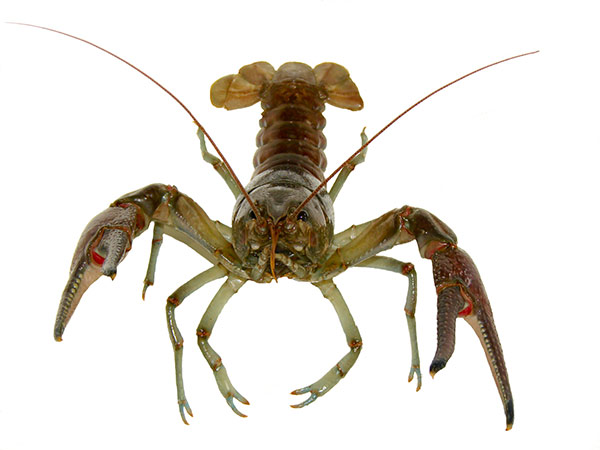
The Invasive Crayfish Collaborative (ICC) is a multidisciplinary program that brings industry, science, and land management stakeholders together to improve the management of invasive crayfish in the Great Lakes region. It is convened and facilitated by Illinois-Indiana Sea Grant and the Illinois Natural History Survey, with funding from the Great Lakes Restoration Initiative.
The ICC is committed to fostering collaboration, building a diverse network, and engaging in science-driven research, management, and outreach. Recognizing that invasive crayfish are the greatest threat to crayfish diversity, the ICC's overarching goal is to protect native crayfish and preserve the delicate balance of aquatic ecosystems.
What’s New
Featured Publications
The ICC develops five-year strategic plan to advance the management of invasive crayfish
The ICC five-year strategic plan, developed with member input, will guide the work of the ICC for the next five years (2025-2029). It aims to foster collaborations across different jurisdictions and disciplines, connect members with stakeholders, and provide members with the necessary resources to reach our mission of reducing the impacts of invasive crayfish in the Great Lakes region.
New crayfish curriculum engages students in Great Lakes and local invasive species issues
Crayfish can frequently be found in the role of classroom pet, but as with many school critters, they can pose a threat if they are released into local waters. A new curriculum brings that lesson directly to students, and teachers too.
News
New book highlights crayfish diversity and importance
Biologist and crayfish expert Zackary Graham’s newly published book, Crayfish, Crawfish, Crawdad: The Biology and Conservation of North America's Favorite Crustaceans, takes readers on a journey from the coalfields of Central Appalachia to the spring-fed water of Northern California, and even in roadside ditches in between. Graham discusses crayfish habitats, anatomy, and coloration. To learn more and read an excerpt, visit the book page. Free electronic exam copies are also available to instructors. Visit the For Educators page for details..
Invasive crayfish native to U.S. found in Ontario waters
Invasive red swamp crayfish were discovered in Ontario waters last fall, prompting wildlife officials to implement mitigation strategies. Officials advise against consuming these crayfish as it could inadvertently encourage their spread to other provincial waterways.
Crayfish map gives conservation a helping claw
Conservation scientists and invasive species managers share a key need: to know where target crayfish are. Researchers at the West University of Timișoara, Romania (WUT) and the University of Illinois Urbana-Champaign have created the first searchable global crayfish atlas, World of Crayfish, with data on 427 crayfish taxa and over 100,000 observations.
Research reveals hope for managing invasive red swamp crayfish
Originally from the southeastern U.S., the red swamp crayfish (Procambarus clarkii) has become an unwelcomed world traveler. Here in the U.S., they are commonly spread by unsuspecting aquarium-hobbyists or biology teachers releasing the unwanted pet into their backyard ponds and rivers. Despite the destructive nature of this species, the U.S. Fish and Wildlife Service haven’t given up the fight.
Literature
Occurrence of Invasive Red Swamp Crayfish (Procambarus clarkii) in the Susquehanna River Basin
Hartzell, S. M. and Lieb, D. A. (2025). Occurrence of Invasive Red Swamp Crayfish (Procambarus clarkii) in the Susquehanna River Basin. Northeastern Naturalist, 32(4), N89-N92. Research Gate PDF Link
Combined effectiveness of light and bait to enhance trapping for monitoring and removal of invasive crayfish: virile crayfish example
Wildhaber, M. L., Bates, B. L., Beaman, Z. D., Bennett, K. R., & West, B. M. (2025). Combined effectiveness of light and bait to enhance trapping for monitoring and removal of invasive crayfish: virile crayfish example. Management of Biological Invasions, 16(4), 1033–1051. doi.org/10.3391/mbi.2025.16.4.08
Genome skimming supports two new crayfish species from the genus Pacifastacus Bott, 1950 (Decapoda: Astacidae)
Larson, E. R., Abbott, C. L., Gilmore, S. R., Helbing, C. C., Lopez, M. L. D., Macintosh, H., Stenhouse, L. M., Williams, B. W. & Usio, N. (2025). Genome skimming supports two new crayfish species from the genus Pacifastacus Bott, 1950 (Decapoda: Astacidae). Zootaxa, 5632 (3), 501–521. doi.org/10.11646/zootaxa.5632.
Movement patterns of invasive red swamp crayfish vary with sex and environmental factors
Raboin, M., Roth, B. M., Sullivan, A., Allert, A. L., Stoeckel, J. A., Nathan, L. R., Quebedeaux, K. B., Sholtis, M. D., Smerud, J. R., Erickson, R. A. & Cupp, A. R. (2025). Movement patterns of invasive red swamp crayfish vary with sex and environmental factors. Scientific Reports, 15, 14312. doi.org/10.1038/s41598-025-96379-8
World of Crayfish™: a web platform towards real-time global mapping of freshwater crayfish and their pathogens
Ion, M. C., Bloomer, C. C., Bărăscu, T. I., et al. (2024). World of Crayfish™: a web platform towards real-time global mapping of freshwater crayfish and their pathogens. PeerJ, 12, e18229. doi.org/10.7717/peerj.18229
EVENTS
Click here to view and register for our upcoming webinars and meetings!
PRODUCTS
Click here to find invasive crayfish products from the ICC and its partners.
JOIN
Interested in learning more about invasive crayfish in the Great Lakes region? Join Us!
CONTACT
Questions about the ICC or crayfish? Suggestions? Please let us know!